



Most CRM projects fail before the software has even been logged into.
That might sound dramatic, especially when modern platforms like SugarAI promise automation, AI powered insights and a complete view of your customer journey. But the reality is far less glamorous than most software demonstrations would have you believe.
Buying a CRM does not magically fix broken processes.
A lot of businesses believe the moment they purchase a CRM licence, everything suddenly falls into place. Sales teams will instantly adopt it. Processes become automated overnight. Reports appear effortlessly. AI starts delivering perfect suggestions. Management gets complete visibility and the business moves faster than ever before.
Unfortunately, that is rarely how it works in the real world.
Six months later, many companies find themselves staring at an expensive system that nobody fully trusts, nobody consistently updates and very few people genuinely enjoy using.
The problem usually is not the CRM itself.
The problem is how businesses think about CRM in the first place.
A CRM Is a Toolbox, Not a Finished Solution
A CRM platform is not a miracle cure for operational problems.
It is a toolbox.
A very powerful toolbox, admittedly, but still only a collection of tools until someone experienced turns it into something useful.
Think about it this way.
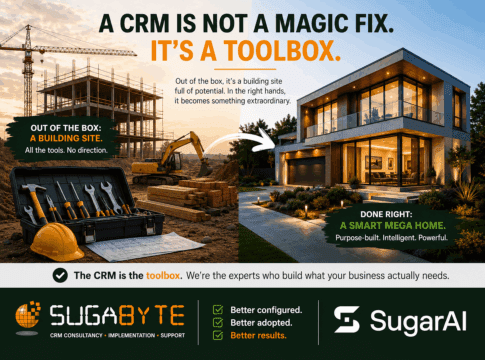
Buying a CRM out of the box is a bit like standing on a building site surrounded by bricks, timber, cement mixers, cranes and diggers. All the materials are there. All the equipment is available. Technically, you have everything needed to build something incredible.
But without architects, builders and a proper plan, you do not end up with a luxury smart home.
You end up with mud, confusion and a half finished structure that nobody quite understands.
CRM implementations work exactly the same way.
The software provides the foundations, but the real value comes from understanding how the business operates and translating those processes into something practical, efficient and easy for teams to use every single day.
Why Professional CRM Implementation Matters
This is where experienced CRM specialists make all the difference.
At Sugabyte, we spend far more time understanding businesses than simply clicking configuration buttons. We look at how enquiries arrive, how quotes are produced, where projects get delayed, how customer service teams operate and what information leadership teams actually need visibility on.
Only then do we shape SugarAI around those workflows.
Sometimes that means simplifying processes that have quietly become far too complicated over the years. Sometimes it means automating repetitive administration that wastes valuable time. Sometimes it means uncovering operational gaps nobody realised were slowing the business down.
Most importantly, it means building a CRM that people actually want to use.
Because good CRM should reduce effort, not create more of it.
Same CRM, Completely Different Outcomes
This is also why two businesses can buy the exact same CRM platform and have completely different experiences.
One company ends up with frustrated staff, unreliable data and poor adoption across the business.
The other ends up with streamlined operations, stronger customer visibility, faster decision making and teams that genuinely benefit from the system every day.
Same software.
Completely different implementation strategy.
That is the part many businesses underestimate.
The Real Transformation Happens After Purchase
SugarAI is an incredibly capable platform. Its AI capabilities, automation tools and flexibility are genuinely impressive. But technology alone is never the answer.
The real transformation happens when experienced professionals take that toolbox and turn it into something purpose built for the business using it.
That is the difference between owning a pile of building materials and living in a fully connected smart mega home.